
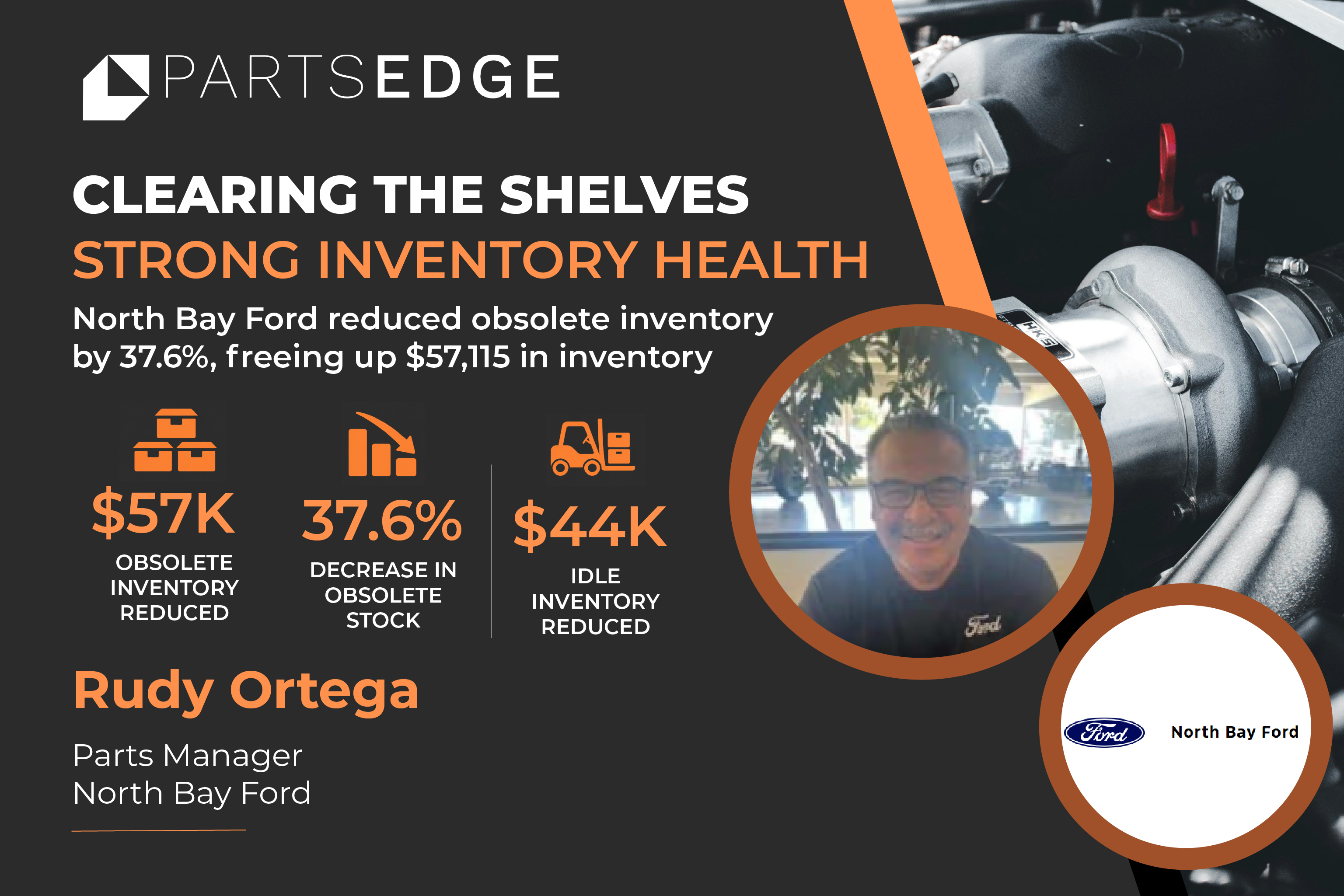
A 37.6% reduction in obsolete stock supports a healthier parts inventory.

“Reducing obsolete inventory has made a real difference in how we're managing our parts department. We're seeing less money tied up in parts that aren't moving and making progress toward a healthier inventory. Having better visibility into those numbers helps us stay focused on where we need to improve.”
Rudy Ortega
Parts Manager, North Bay Ford

About North Bay Ford
North Bay Ford's parts department, led by Parts Manager Rudy Ortega, has made measurable progress in improving inventory health by reducing obsolete stock and increasing productive inventory. With PartsEdge supporting inventory visibility and analysis, the dealership's results from October 2025 through September 2026 reflect a stronger balance between parts that meet stocking requirements and inventory that has not generated sales activity.
The Challenge
Obsolete inventory ties up valuable capital in parts that have remained on the shelf without generating sales. In October 2025, North Bay Ford carried $152,022 in obsolete inventory, representing a significant investment in parts that had not sold in more than 12 months. The dealership needed to reduce that inventory while maintaining productive stock and improving the overall allocation of its parts inventory investment.
The Solution
With PartsEdge providing greater visibility into inventory performance, North Bay Ford's results reflect progress in reducing obsolete stock while maintaining a focus on productive inventory. Monitoring parts that have not generated sales in more than a year, alongside inventory that meets established stocking and sales criteria, provides a clearer picture of where inventory dollars are allocated. These insights support a more balanced inventory strategy and help identify additional opportunities for improvement, including forced inventory that remains above its historical average.
The Results
From October 2025 to September 2026, North Bay Ford reduced Obsolete Inventory from $152,022 to $94,907, a decrease of $57,115, or 37.6%. This improvement represents significantly less capital tied up in parts that had not sold in more than a year. During the same period, Productive Inventory increased from $66,168 to $69,031, a gain of $2,863, or 4.3%, while Total Inventory decreased $23,300, or 5.8%, from $403,022 to $379,722. Combined Idle Inventory also declined by $43,943, or 17.2%, according to the dealership's inventory summary. The additional productive stock represents an estimated $1,059 in potential gross profit at a 37% margin, assuming the inventory generates sales. Although Forced Inventory remains 12.7% above its historical average and warrants continued attention, the substantial reduction in obsolete inventory demonstrates meaningful progress toward a healthier inventory investment.
Submit a Comment
Your email address will not be published. Required fields are marked *